AI Voice Agents vs. Human SDRs: What's Actually Better for Lead Qualification ?
AI Voice Agents vs. Human SDRs: What's Actually Better for Lead Qualification ?
AI Voice Agents vs. Human SDRs: What's Actually Better for Lead Qualification ?
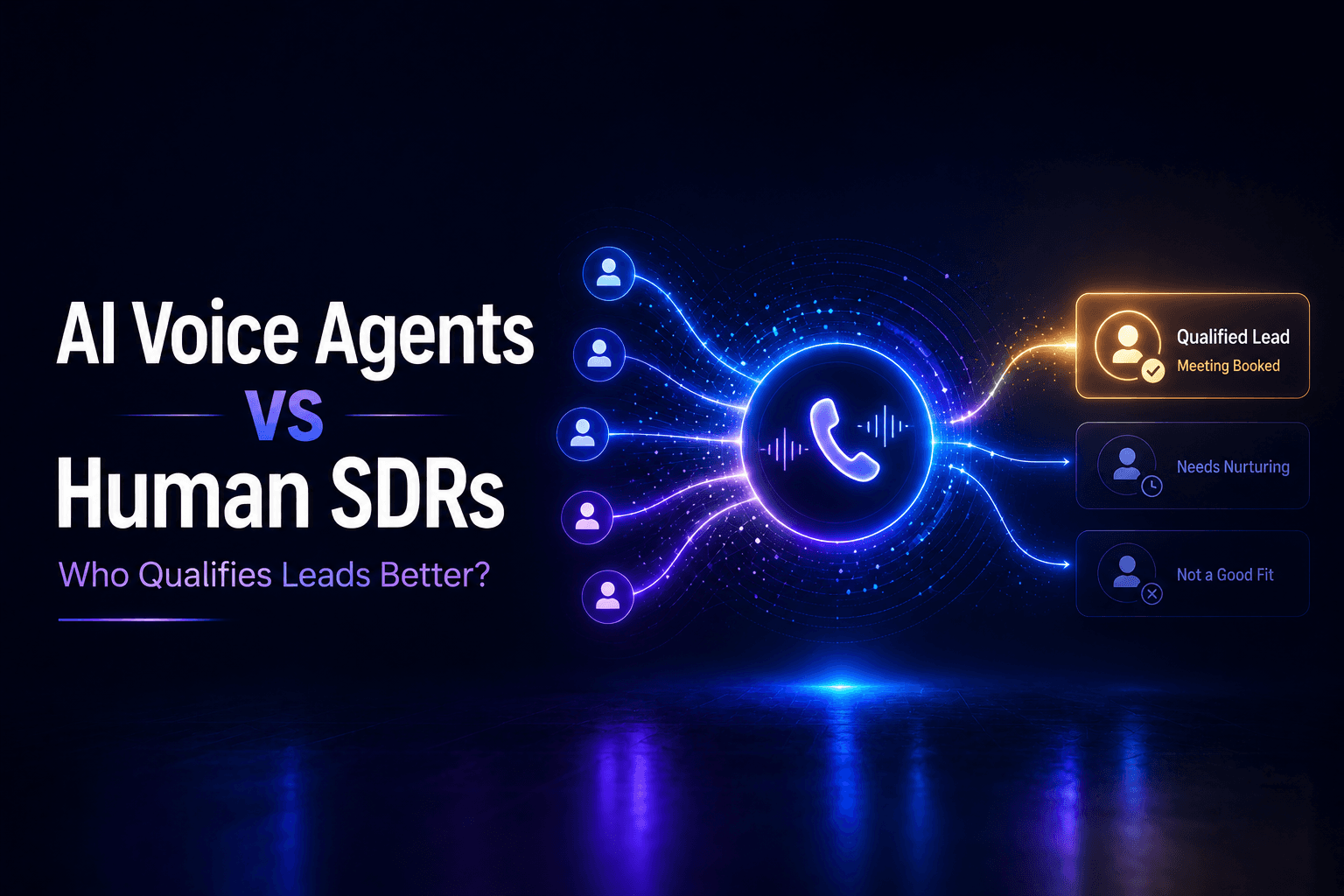
Every sales team faces the same problem. Leads come in, the team is busy, and by the time someone picks up the phone the prospect has already moved on. In a world where intent fades within minutes, how quickly you respond to a lead matters just as much as the lead itself.
This debate AI voice agents vs. human SDRs is not about technology replacing people. It is about understanding what works better, when, and for which part of your sales process.
What AI Voice Agents Actually Do in a Sales Call
Most people picture a robot reading from a script. The reality in 2026 is very different.
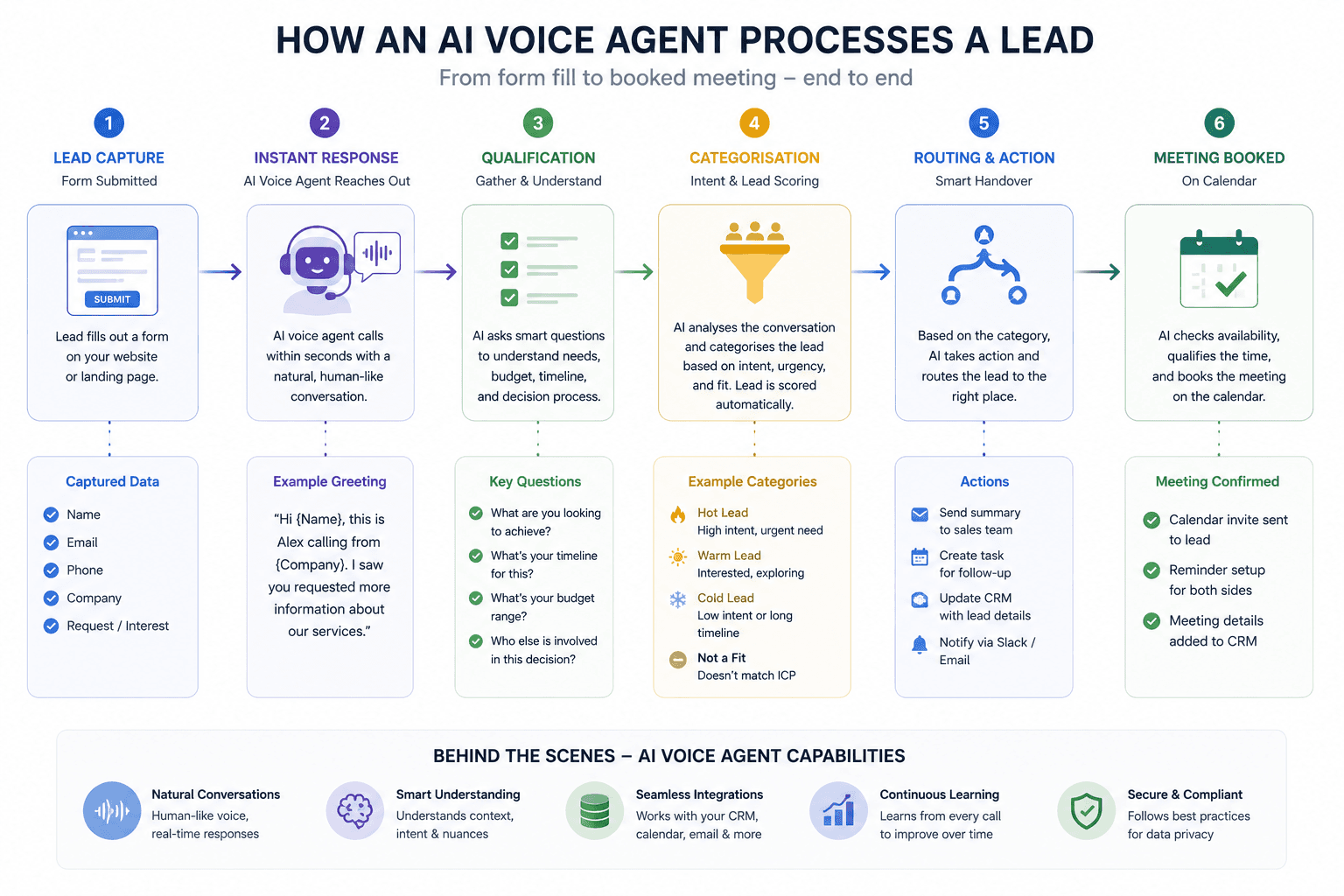
Modern AI voice agents can hold natural, two-way conversations. They listen, ask follow-up questions, handle basic objections, and categorise a lead all in real time, without a human in the loop. The moment someone fills out a form, the AI calls them back within seconds, qualifies them through a structured conversation, and either books a meeting or marks the lead accordingly.
No delays. No missed calls. No manual data entry.
Stat: Companies that respond to leads within 1 minute see a 391% increase in conversions compared to those that respond after 5 minutes. (Velocify)
Stat: The average business takes 47 hours to respond to a new lead. (Harvard Business Review)
Where Human SDRs Still Have the Edge
Let's be honest there are situations where a human will always perform better.
Complex, high-value deals require real rapport. When a prospect is evaluating a significant purchase, they want to speak with someone who understands their business, can go off-script, and can build trust over multiple conversations.
Emotionally sensitive industries like healthcare, legal, or financial services need empathy that no ai voice agent development can fully replicate yet.
Strategic relationship building over months or years the kind that leads to long-term enterprise contracts still runs on human connection, context, and instinct.
The honest answer is that human SDRs are not going anywhere. But the volume of repetitive, time-sensitive qualification work they currently handle? That is exactly where AI wins.
Stat: 82% of buyers still want human interaction when making complex purchase decisions. (Salesforce)
Cost Comparison: AI Agent vs. Full-Time SDR
The numbers here are difficult to ignore.
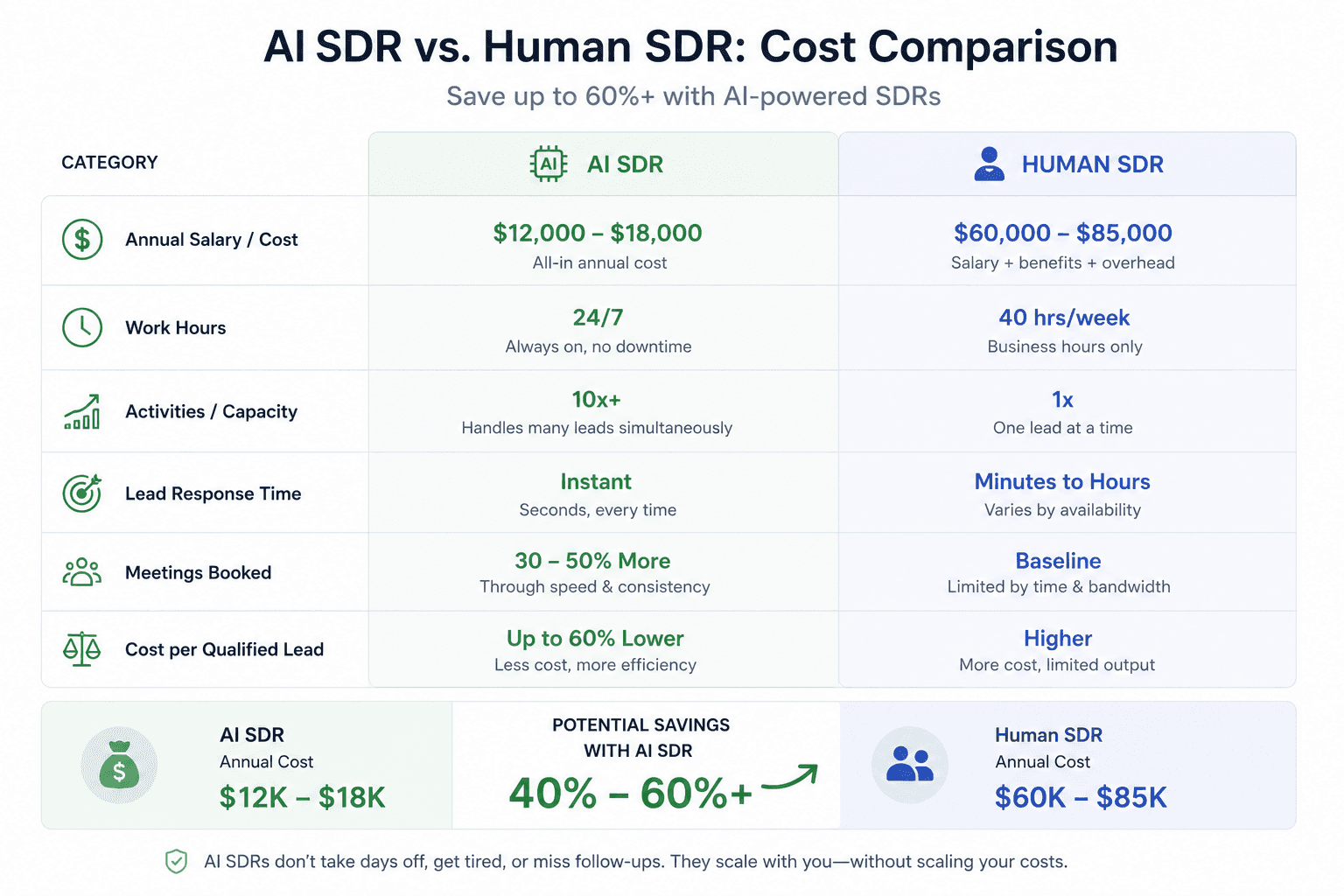
A full-time SDR costs ₹4–10 lakhs per year in India, or $50,000–$80,000 in the US before you add recruitment, training, benefits, and turnover costs. An ai automation company delivering voice agent solutions charges a fraction of that, and one AI agent can handle hundreds of simultaneous calls around the clock.
Human SDR | AI Voice Agent | |
Monthly Cost | ₹35,000–₹80,000 | ₹8,000–₹25,000 |
Working Hours | 8–9 hrs/day | 24/7 |
Simultaneous Calls | 1 | Unlimited |
Consistency | Variable | Always consistent |
Scalability | Hire more | Scale instantly |
For any business automation company handling high lead volumes, the cost advantage of AI is measurable and immediate.
Stat: AI-powered sales tools reduce the cost per qualified lead by up to 60%. (McKinsey & Company)
Speed and Availability: 24/7 vs. Business Hours
Leads do not arrive between 9am and 5pm. Someone fills out your form at 11pm on a Sunday, and by Monday morning when your SDR calls they have already spoken to two competitors.
AI voice agents respond within seconds of a lead coming in. Lead intent is at its highest the moment someone submits a form and it drops sharply with every passing minute. This is where ai workflow automation creates a real, measurable advantage that no human team can match purely through effort.
For businesses targeting international markets, this also removes the need to build regional SDR teams just to cover different time zones.
Stat: Leads contacted within 5 minutes are 9x more likely to convert than those contacted after 10 minutes. (MIT Lead Response Management Study)
Stat: 30–50% of sales go to the vendor that responds first. (HubSpot)
Accuracy in Lead Qualification and Categorisation
One of the biggest hidden costs in sales is the time wasted on leads that were never going to convert.
Human SDRs, even great ones, are inconsistent. They have good days and bad days. They make assumptions. They occasionally pass a weak lead forward because they liked the person on the phone.
Agentic ai solutions qualify based on fixed, data-driven criteria every single time. No bias. No fatigue. No guessing. Every lead gets scored based on real conversation signals, categorised consistently, and logged directly into the CRM giving your sales team clean, structured data to work with.
Stat: Sales reps spend only 33% of their time actually selling the rest goes to admin and unqualified follow-ups. (Salesforce)
Stat: AI-assisted lead qualification improves sales team productivity by up to 40%. (Gartner)
Which Model Works Best for Your Business Size?
Small businesses and startups If you are generating leads but cannot afford a full SDR team, ai voice agents let you respond professionally to every lead instantly, without the overhead. It replaces what would otherwise require two or three hires.
Mid-size businesses A hybrid model works best here. Use AI for initial qualification and triage, then pass Hot leads to human SDRs for relationship building and closing. You get speed on the front end and judgment on the back end.
Large enterprises Enterprise ai automation solves the volume problem completely. Thousands of leads per month get qualified and routed instantly, while your human team focuses on high-value accounts that genuinely need their expertise.
The right question is not "AI or human?" it is "which part of your sales process needs speed and scale, and which part needs empathy and judgment?"
Stat: Businesses using AI in their sales process report a 50% increase in leads and a 60–70% reduction in call time. (McKinsey)
Frequently Asked Questions
1. Can AI voice agents really hold a natural conversation?
Yes. Modern ai voice agents built on advanced generative ai services listen, respond, and adapt in real time most prospects experience it as a completely natural call.
2. Will prospects know they are talking to an AI?
It depends on how the business configures it. What matters most to prospects is speed and accuracy both of which AI handles well.
3. Is AI voice agent technology expensive?
Not compared to a full SDR team. Most ai development services solutions are priced on a per-lead or monthly basis, making them accessible for businesses of all sizes.
4. What happens to leads the AI cannot handle?
Any lead outside the AI's criteria or one that asks for a human gets escalated immediately with full conversation context already logged.
5. How does the AI improve over time?
Agentic ai solutions learn from every conversation, continuously improving qualification accuracy and lead categorisation the more data they process.
AI Voice Agents vs. Human SDRs: What's Actually Better for Lead Qualification ?
Every sales team faces the same problem. Leads come in, the team is busy, and by the time someone picks up the phone the prospect has already moved on. In a world where intent fades within minutes, how quickly you respond to a lead matters just as much as the lead itself.
This debate AI voice agents vs. human SDRs is not about technology replacing people. It is about understanding what works better, when, and for which part of your sales process.
What AI Voice Agents Actually Do in a Sales Call
Most people picture a robot reading from a script. The reality in 2026 is very different.
Modern AI voice agents can hold natural, two-way conversations. They listen, ask follow-up questions, handle basic objections, and categorise a lead all in real time, without a human in the loop. The moment someone fills out a form, the AI calls them back within seconds, qualifies them through a structured conversation, and either books a meeting or marks the lead accordingly.
No delays. No missed calls. No manual data entry.
Stat: Companies that respond to leads within 1 minute see a 391% increase in conversions compared to those that respond after 5 minutes. (Velocify)
Stat: The average business takes 47 hours to respond to a new lead. (Harvard Business Review)
Where Human SDRs Still Have the Edge
Let's be honest there are situations where a human will always perform better.
Complex, high-value deals require real rapport. When a prospect is evaluating a significant purchase, they want to speak with someone who understands their business, can go off-script, and can build trust over multiple conversations.
Emotionally sensitive industries like healthcare, legal, or financial services need empathy that no ai voice agent development can fully replicate yet.
Strategic relationship building over months or years the kind that leads to long-term enterprise contracts still runs on human connection, context, and instinct.
The honest answer is that human SDRs are not going anywhere. But the volume of repetitive, time-sensitive qualification work they currently handle? That is exactly where AI wins.
Stat: 82% of buyers still want human interaction when making complex purchase decisions. (Salesforce)
Cost Comparison: AI Agent vs. Full-Time SDR
The numbers here are difficult to ignore.
A full-time SDR costs ₹4–10 lakhs per year in India, or $50,000–$80,000 in the US before you add recruitment, training, benefits, and turnover costs. An ai automation company delivering voice agent solutions charges a fraction of that, and one AI agent can handle hundreds of simultaneous calls around the clock.
Human SDR | AI Voice Agent | |
Monthly Cost | ₹35,000–₹80,000 | ₹8,000–₹25,000 |
Working Hours | 8–9 hrs/day | 24/7 |
Simultaneous Calls | 1 | Unlimited |
Consistency | Variable | Always consistent |
Scalability | Hire more | Scale instantly |
For any business automation company handling high lead volumes, the cost advantage of AI is measurable and immediate.
Stat: AI-powered sales tools reduce the cost per qualified lead by up to 60%. (McKinsey & Company)
Speed and Availability: 24/7 vs. Business Hours
Leads do not arrive between 9am and 5pm. Someone fills out your form at 11pm on a Sunday, and by Monday morning when your SDR calls they have already spoken to two competitors.
AI voice agents respond within seconds of a lead coming in. Lead intent is at its highest the moment someone submits a form and it drops sharply with every passing minute. This is where ai workflow automation creates a real, measurable advantage that no human team can match purely through effort.
For businesses targeting international markets, this also removes the need to build regional SDR teams just to cover different time zones.
Stat: Leads contacted within 5 minutes are 9x more likely to convert than those contacted after 10 minutes. (MIT Lead Response Management Study)
Stat: 30–50% of sales go to the vendor that responds first. (HubSpot)
Accuracy in Lead Qualification and Categorisation
One of the biggest hidden costs in sales is the time wasted on leads that were never going to convert.
Human SDRs, even great ones, are inconsistent. They have good days and bad days. They make assumptions. They occasionally pass a weak lead forward because they liked the person on the phone.
Agentic ai solutions qualify based on fixed, data-driven criteria every single time. No bias. No fatigue. No guessing. Every lead gets scored based on real conversation signals, categorised consistently, and logged directly into the CRM giving your sales team clean, structured data to work with.
Stat: Sales reps spend only 33% of their time actually selling the rest goes to admin and unqualified follow-ups. (Salesforce)
Stat: AI-assisted lead qualification improves sales team productivity by up to 40%. (Gartner)
Which Model Works Best for Your Business Size?
Small businesses and startups If you are generating leads but cannot afford a full SDR team, ai voice agents let you respond professionally to every lead instantly, without the overhead. It replaces what would otherwise require two or three hires.
Mid-size businesses A hybrid model works best here. Use AI for initial qualification and triage, then pass Hot leads to human SDRs for relationship building and closing. You get speed on the front end and judgment on the back end.
Large enterprises Enterprise ai automation solves the volume problem completely. Thousands of leads per month get qualified and routed instantly, while your human team focuses on high-value accounts that genuinely need their expertise.
The right question is not "AI or human?" it is "which part of your sales process needs speed and scale, and which part needs empathy and judgment?"
Stat: Businesses using AI in their sales process report a 50% increase in leads and a 60–70% reduction in call time. (McKinsey)
Frequently Asked Questions
1. Can AI voice agents really hold a natural conversation?
Yes. Modern ai voice agents built on advanced generative ai services listen, respond, and adapt in real time most prospects experience it as a completely natural call.
2. Will prospects know they are talking to an AI?
It depends on how the business configures it. What matters most to prospects is speed and accuracy both of which AI handles well.
3. Is AI voice agent technology expensive?
Not compared to a full SDR team. Most ai development services solutions are priced on a per-lead or monthly basis, making them accessible for businesses of all sizes.
4. What happens to leads the AI cannot handle?
Any lead outside the AI's criteria or one that asks for a human gets escalated immediately with full conversation context already logged.
5. How does the AI improve over time?
Agentic ai solutions learn from every conversation, continuously improving qualification accuracy and lead categorisation the more data they process.
Copyright © 2026 Tapitt. All rights reserved. • Privacy Policy
Copyright © 2026 Tapitt. All rights reserved. • Privacy Policy
Copyright © 2026 Tapitt. All rights reserved. • Privacy Policy