What Makes a High-Converting Website in 2026?
What Makes a High-Converting Website in 2026?

What Makes a High-Converting Website in 2026?
You are running ads, posting on social media, and putting in the work. But your website is not delivering. Visitors come and leave without doing anything.
The problem is rarely the traffic. It is the website itself.
In 2026, your website is your most important sales tool. And a high-converting website is not just about looking good it is about guiding the right person to take the right action. Here is what actually makes the difference.
1.The 6 Elements That Separate High-Converting Websites from the Rest
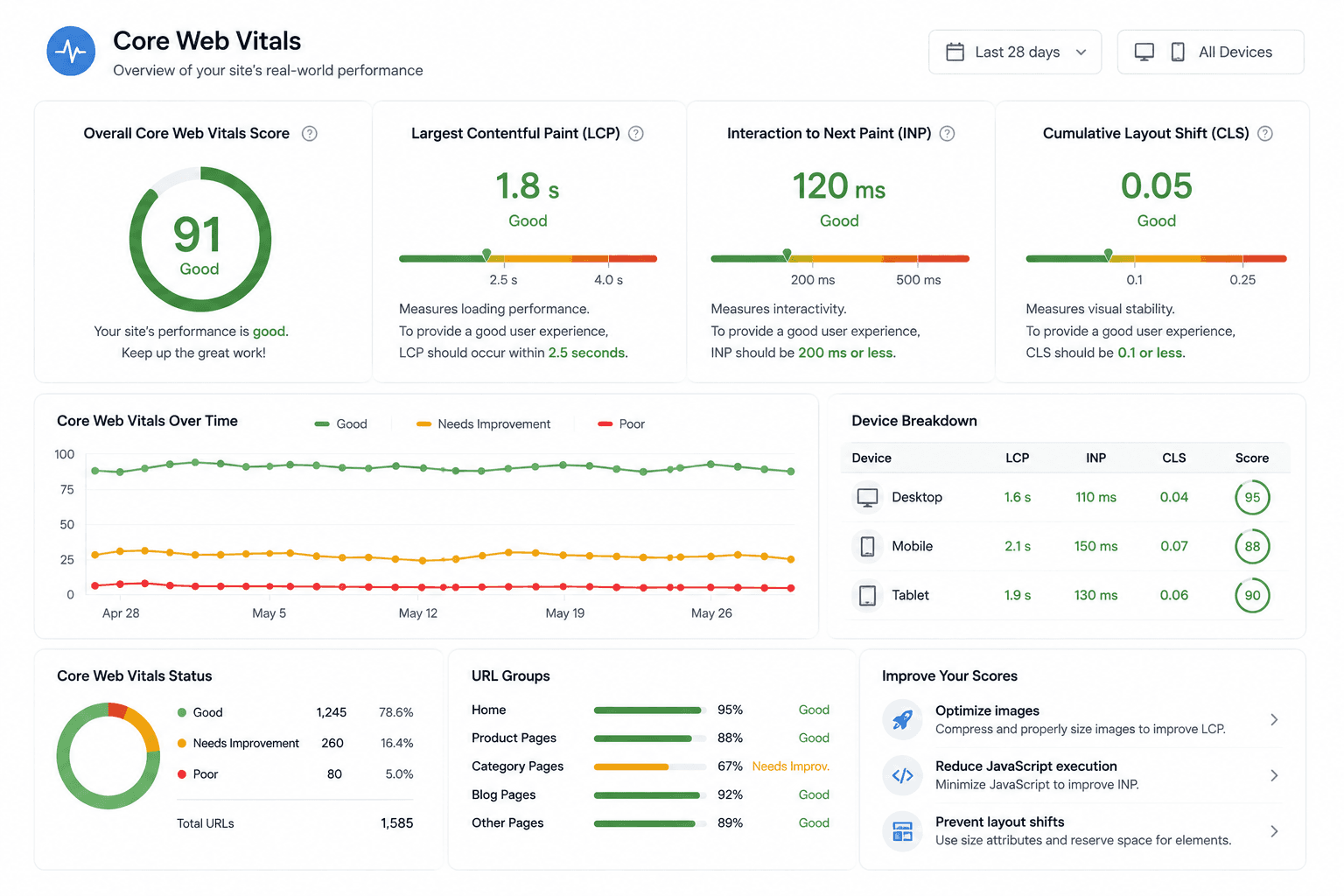
1. Speed and Core Web Vitals The Foundation Everything Sits On
If your site is slow, nothing else matters. Visitors will not wait, and Google will not rank you.
Core Web Vitals Google's set of performance metrics measure how fast your page loads, how quickly it responds to clicks, and how stable the layout is while loading. In 2026, these directly impact both your search rankings and your conversions.
Any serious web development company will tell you: speed is a feature, not an afterthought. Compress images, use a CDN, and invest in good hosting.
Stat: A 1-second delay in page load time reduces conversions by up to 7%. (Akamai)
Stat: 53% of mobile users abandon a site that takes more than 3 seconds to load. (Google)
2. Above-the-Fold Design First Impressions Are Everything
Everything a visitor sees before they scroll needs to answer three questions instantly:
Am I in the right place?
Can this brand solve my problem?
What should I do next?
A clear headline, a short supporting line, and one obvious next step. That is it. Avoid clutter, avoid vague messaging, and avoid talking about yourself before you have addressed the visitor's need.
Stat: You have roughly 50 milliseconds to make a first impression on a new visitor. (Google Research)
3. Clear CTAs Tell People Exactly What to Do
A weak call to action is one of the most common reasons websites do not convert. "Contact Us" and "Learn More" are not CTAs they are placeholders.
Specific CTAs win. "Get My Free Website Audit" outperforms "Submit." "Start My Project" outperforms "Click Here." Place them above the fold, after key benefits, and after testimonials not just at the bottom of the page.
This applies across all web development services and landing pages. Every moment a visitor thinks "okay, I'm interested" there should be a CTA ready for them.
Stat: Personalised CTAs perform 202% better than generic ones. (HubSpot)
4. Mobile-First Design Non-Negotiable
Over 60% of global web traffic comes from mobile. If your website is not built mobile-first not just "responsive," but genuinely designed for small screens first you are losing more than half your audience.
Google has indexed the mobile version of websites first since 2021. A poor mobile experience hurts your rankings just as much as your conversions.
For any web development company in Vadodara or anywhere building in 2026, mobile-first is the baseline not the bonus.
Stat: 57% of users say they won't recommend a business with a poorly designed mobile site. (socPub)
5. Trust Signals Because People Buy from Brands They Believe In
You can have the fastest, cleanest website in the world but if visitors do not trust you, they will not convert.
Trust is built through specifics: real testimonials with real results, case studies showing before and after, client logos, certifications, and actual team photos. For digital marketing services and web development services especially, case studies are often the most persuasive content on the entire site.
Generic stock photos and vague five-star reviews do not build trust. Specificity does.
Stat: 88% of consumers trust online reviews as much as personal recommendations. (BrightLocal)
6. A/B Testing Winning Websites Are Never Finished
Here is what the best performance marketing services teams know: you do not build a high-converting website once and walk away. You build version one, measure it, and keep improving.
A/B testing means running two versions of a page element a headline, a CTA, a form to see which performs better. One test at a time. Let data decide, not opinion. Small improvements compound into significantly better results over time.
Stat: Brands that continuously test see conversion rates up to 400% higher than those that do not. (VWO)
2.Quick Audit Checklist Before You Send Traffic
Before you run a single ad or push visitors to your site, ask yourself:
Does my site load in under 3 seconds on mobile?
Does my above-the-fold section clearly explain what I offer and who it is for?
Are my CTAs specific and placed at multiple points on the page?
Is the mobile experience clean and frictionless?
Do I have testimonials, case studies, or certifications visible?
Am I running regular A/B tests?
If you answered no to even two of these you have found your starting point.
Frequently Asked Questions
1.What is the most important factor for a high-converting website?
Speed is the foundation. After that, a clear value proposition above the fold and strong CTAs have the biggest impact on conversions.
2.How often should I A/B test my website?
Continuously. Start with your most trafficked pages and highest-value elements. Run one test at a time and apply the winner before moving to the next.
3.Does mobile design really affect conversions?
Absolutely. With most traffic coming from mobile, a poor mobile experience means losing the majority of your visitors before they even read your offer.
4.How do I know if my website is converting well?
A conversion rate above 3–5% is a solid benchmark. Top-performing websites convert at 10%+. Track bounce rate, time on page, and CPA alongside conversion rate for a complete picture.
What Makes a High-Converting Website in 2026?
You are running ads, posting on social media, and putting in the work. But your website is not delivering. Visitors come and leave without doing anything.
The problem is rarely the traffic. It is the website itself.
In 2026, your website is your most important sales tool. And a high-converting website is not just about looking good it is about guiding the right person to take the right action. Here is what actually makes the difference.
1.The 6 Elements That Separate High-Converting Websites from the Rest
1. Speed and Core Web Vitals The Foundation Everything Sits On
If your site is slow, nothing else matters. Visitors will not wait, and Google will not rank you.
Core Web Vitals Google's set of performance metrics measure how fast your page loads, how quickly it responds to clicks, and how stable the layout is while loading. In 2026, these directly impact both your search rankings and your conversions.
Any serious web development company will tell you: speed is a feature, not an afterthought. Compress images, use a CDN, and invest in good hosting.
Stat: A 1-second delay in page load time reduces conversions by up to 7%. (Akamai)
Stat: 53% of mobile users abandon a site that takes more than 3 seconds to load. (Google)
2. Above-the-Fold Design First Impressions Are Everything
Everything a visitor sees before they scroll needs to answer three questions instantly:
Am I in the right place?
Can this brand solve my problem?
What should I do next?
A clear headline, a short supporting line, and one obvious next step. That is it. Avoid clutter, avoid vague messaging, and avoid talking about yourself before you have addressed the visitor's need.
Stat: You have roughly 50 milliseconds to make a first impression on a new visitor. (Google Research)
3. Clear CTAs Tell People Exactly What to Do
A weak call to action is one of the most common reasons websites do not convert. "Contact Us" and "Learn More" are not CTAs they are placeholders.
Specific CTAs win. "Get My Free Website Audit" outperforms "Submit." "Start My Project" outperforms "Click Here." Place them above the fold, after key benefits, and after testimonials not just at the bottom of the page.
This applies across all web development services and landing pages. Every moment a visitor thinks "okay, I'm interested" there should be a CTA ready for them.
Stat: Personalised CTAs perform 202% better than generic ones. (HubSpot)
4. Mobile-First Design Non-Negotiable
Over 60% of global web traffic comes from mobile. If your website is not built mobile-first not just "responsive," but genuinely designed for small screens first you are losing more than half your audience.
Google has indexed the mobile version of websites first since 2021. A poor mobile experience hurts your rankings just as much as your conversions.
For any web development company in Vadodara or anywhere building in 2026, mobile-first is the baseline not the bonus.
Stat: 57% of users say they won't recommend a business with a poorly designed mobile site. (socPub)
5. Trust Signals Because People Buy from Brands They Believe In
You can have the fastest, cleanest website in the world but if visitors do not trust you, they will not convert.
Trust is built through specifics: real testimonials with real results, case studies showing before and after, client logos, certifications, and actual team photos. For digital marketing services and web development services especially, case studies are often the most persuasive content on the entire site.
Generic stock photos and vague five-star reviews do not build trust. Specificity does.
Stat: 88% of consumers trust online reviews as much as personal recommendations. (BrightLocal)
6. A/B Testing Winning Websites Are Never Finished
Here is what the best performance marketing services teams know: you do not build a high-converting website once and walk away. You build version one, measure it, and keep improving.
A/B testing means running two versions of a page element a headline, a CTA, a form to see which performs better. One test at a time. Let data decide, not opinion. Small improvements compound into significantly better results over time.
Stat: Brands that continuously test see conversion rates up to 400% higher than those that do not. (VWO)
2.Quick Audit Checklist Before You Send Traffic
Before you run a single ad or push visitors to your site, ask yourself:
Does my site load in under 3 seconds on mobile?
Does my above-the-fold section clearly explain what I offer and who it is for?
Are my CTAs specific and placed at multiple points on the page?
Is the mobile experience clean and frictionless?
Do I have testimonials, case studies, or certifications visible?
Am I running regular A/B tests?
If you answered no to even two of these you have found your starting point.
Frequently Asked Questions
1.What is the most important factor for a high-converting website?
Speed is the foundation. After that, a clear value proposition above the fold and strong CTAs have the biggest impact on conversions.
2.How often should I A/B test my website?
Continuously. Start with your most trafficked pages and highest-value elements. Run one test at a time and apply the winner before moving to the next.
3.Does mobile design really affect conversions?
Absolutely. With most traffic coming from mobile, a poor mobile experience means losing the majority of your visitors before they even read your offer.
4.How do I know if my website is converting well?
A conversion rate above 3–5% is a solid benchmark. Top-performing websites convert at 10%+. Track bounce rate, time on page, and CPA alongside conversion rate for a complete picture.
Copyright © 2026 Tapitt. All rights reserved. • Privacy Policy
Copyright © 2026 Tapitt. All rights reserved. • Privacy Policy
Copyright © 2026 Tapitt. All rights reserved. • Privacy Policy