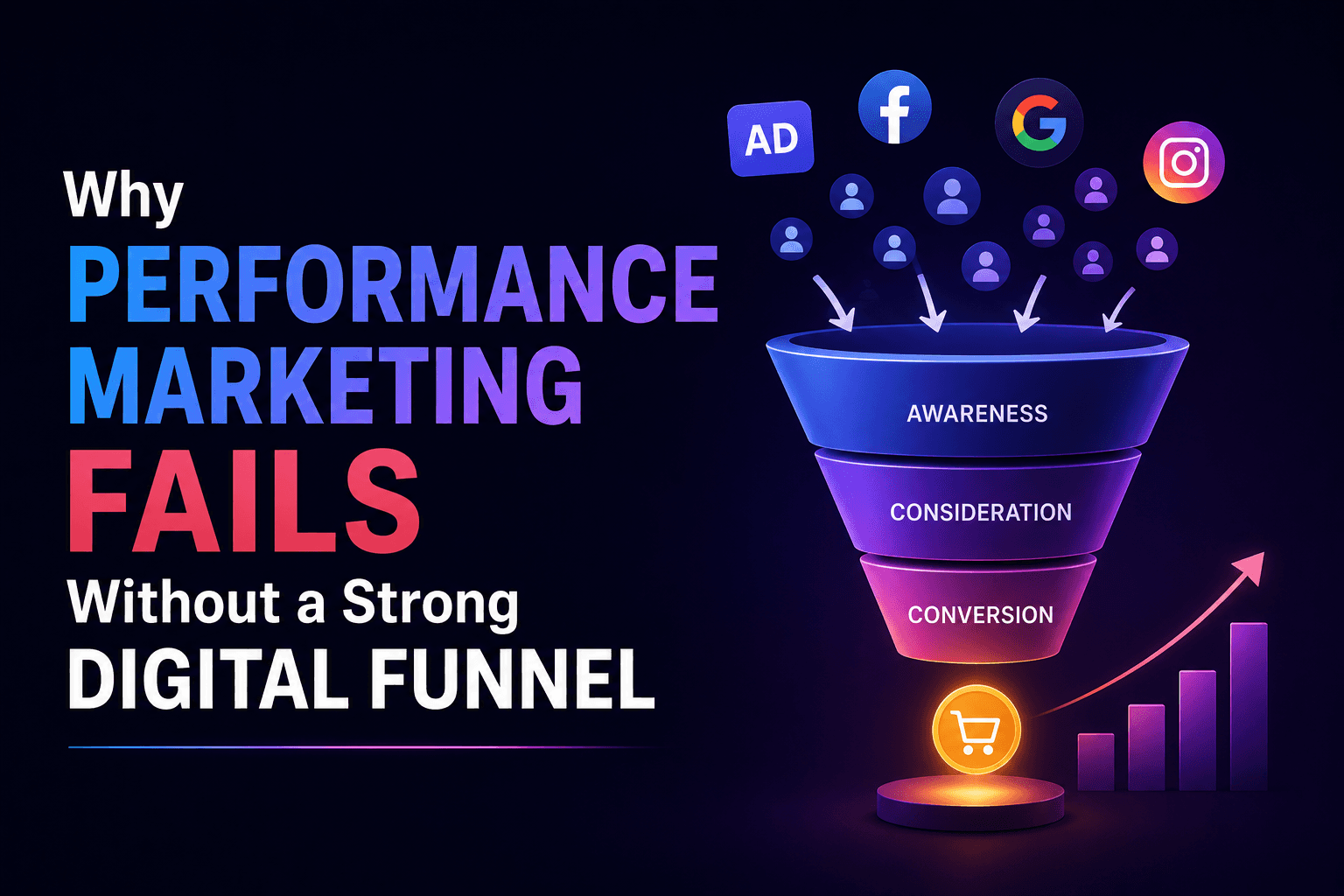
Why Performance Marketing Fails Without a Strong Digital Funnel
Why Performance Marketing Fails Without a Strong Digital Funnel
Why Performance Marketing Fails Without a Strong Digital Funnel
You launched the campaign. The ads look great. Clicks are coming in.
Then you check your sales. Nothing.
This happens to businesses constantly and most of them blame the ads. They tweak the creative, adjust the audience, increase the budget. Results barely move. Because the ads were never the problem. What sits between the ad and the sale is where the real issue lives. And most businesses have never properly built it.
1.What a Digital Funnel Actually Looks Like
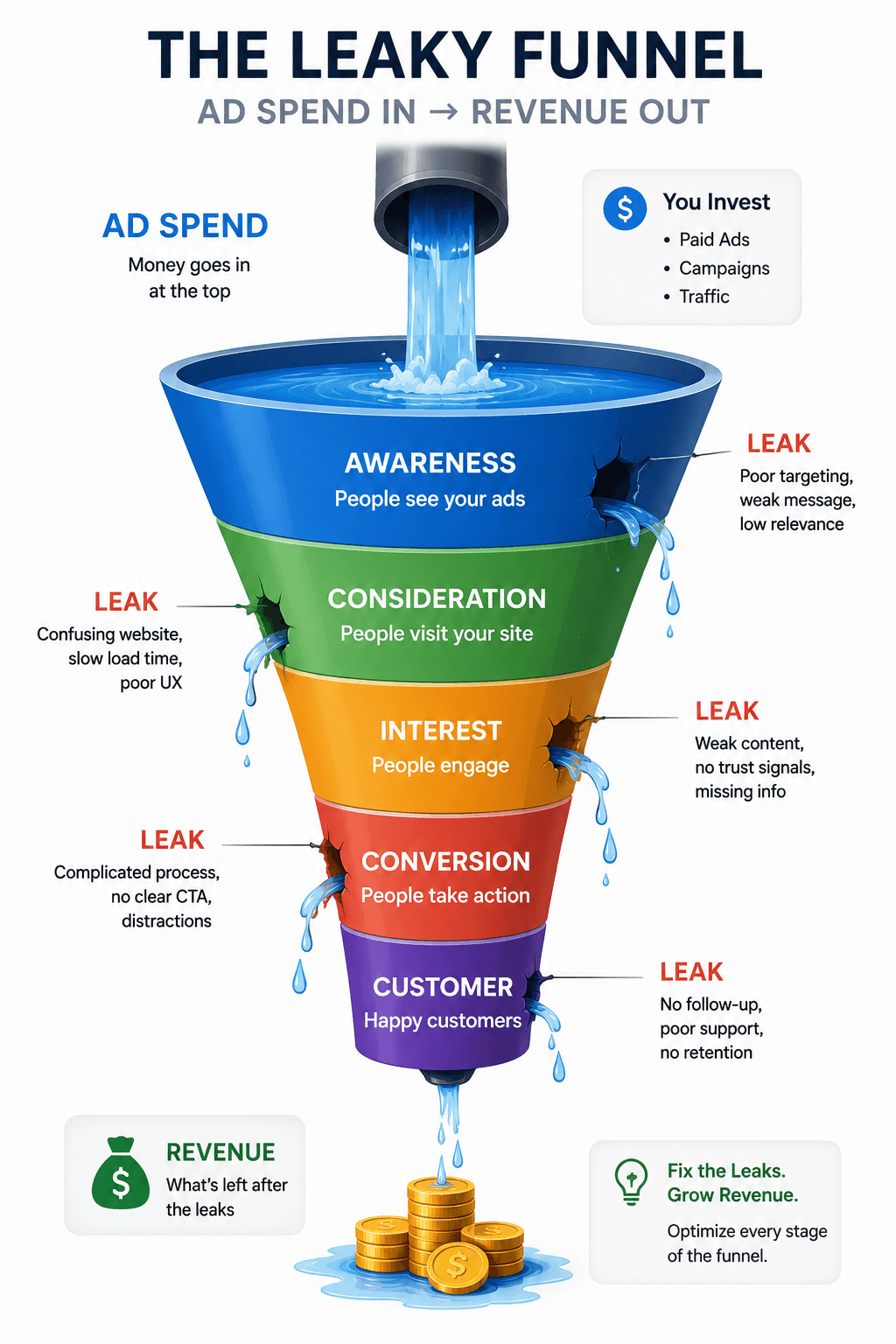
Strip away the jargon and a digital funnel is a simple idea. It is the path someone travels from not knowing you exist to eventually buying from you. It is called a funnel because at every step, some people fall away you start wide at the top and end with buyers at the bottom.
There are three stages, and each one has a completely different job.
At the top, people are just discovering you. They saw your ad, came across your content, or heard your name somewhere. They are curious at best. Nowhere near ready to buy.
In the middle, things get more serious. These people are now comparing options visiting your site, reading reviews, checking out competitors. This is the stage where trust either gets built or does not.
At the bottom, the decision is happening. Someone has decided they want what you offer. Now it comes down to whether the experience of actually buying is smooth enough to close things out.
Stat: Brands with a clearly defined customer journey see a 54% higher return on marketing spend. (McKinsey)
Stat: It takes an average of 6 to 8 touchpoints before someone becomes a customer. One ad almost never does it alone. (Salesforce)
2.The Mistakes That Quietly Drain Your Budget
Most businesses running ads are not making obvious errors. The problems are subtler and harder to catch because on the surface, things look like they are working.
Sending everyone to the homepage is probably the most common one. Your homepage introduces your brand to everyone. A paid ad brings in someone with a very specific intent. Those two things do not match, and people bounce almost immediately.
Skipping the middle of the funnel is another costly habit. Brands run awareness campaigns at the top and retargeting at the bottom but put nothing in between. No emails, no nurture content, no reason for someone to stay interested between their first visit and their eventual decision. That gap is where most leads disappear.
Assuming one visit will convert is where a lot of budget silently burns.
Stat: 96% of people who land on your website are not ready to buy on that first visit. (Marketo)
If there is no system to bring them back no follow-up, no retargeting, no email sequence that click is gone forever. You paid for it and got nothing from it.
A slow or confusing landing page finishes off what the ad started. Creative and targeting can only carry someone so far.
Stat: A single second delay in page load time reduces conversions by up to 7%. (Akamai)
3.The Hard Truth About Ad Spend Without a Funnel
Running performance marketing without a funnel is not really a strategy. It is paying for a queue of people to walk up to a door that does not open.
The ad does its job. It creates a click, brings someone into your world. But the moment they arrive, there is nothing there to catch them. No clear next step. No reason to stay. No follow-up when they leave. And you still pay for every one of those clicks.
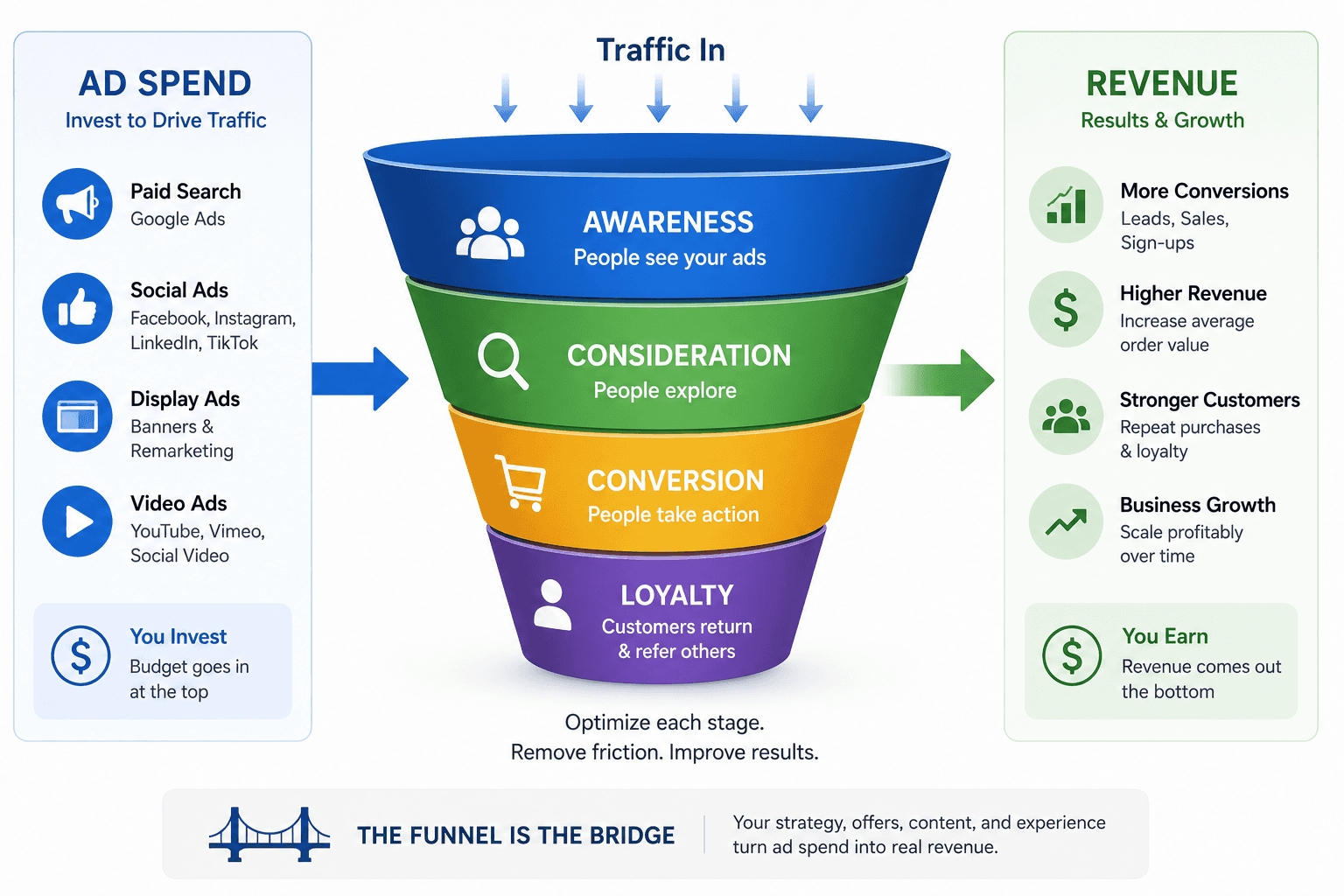
A digital funnel is the infrastructure that makes ads actually work. Without it, you are buying traffic not building a customer base.
Stat: Businesses using proper funnel strategies generate 451% more qualified leads than those without one. (The Annuitas Group)
Stat: 79% of marketing leads never convert not because they were poor leads, but because no one nurtured them. (HubSpot)
Stat: Leads that go through a nurture sequence spend 47% more on their first purchase. (The Annuitas Group)
The businesses consistently winning at performance marketing are not running the cleverest ads. They have built the strongest systems behind those ads.
4.Map the Customer Journey Before You Run a Single Ad
This is the step most businesses skip. Before setting a budget or writing a line of copy, you need to genuinely understand the journey your customer takes not the one you assume they take.
Get specific about who you are talking to. Not a broad demographic. What does this person worry about? What has already frustrated them about finding a solution? What would make them trust you enough to take the next step?
Map every touchpoint. Google, Instagram, a friend's recommendation, a YouTube ad. Each one is an entry point into your funnel at a different level of awareness.
Think about what they are asking at each stage. Early on the question is "what even is this?" In the middle it becomes "is this right for me?" At the bottom it shifts to "can I actually trust these people?" Your content and ads need to answer whichever question is most relevant in that moment.
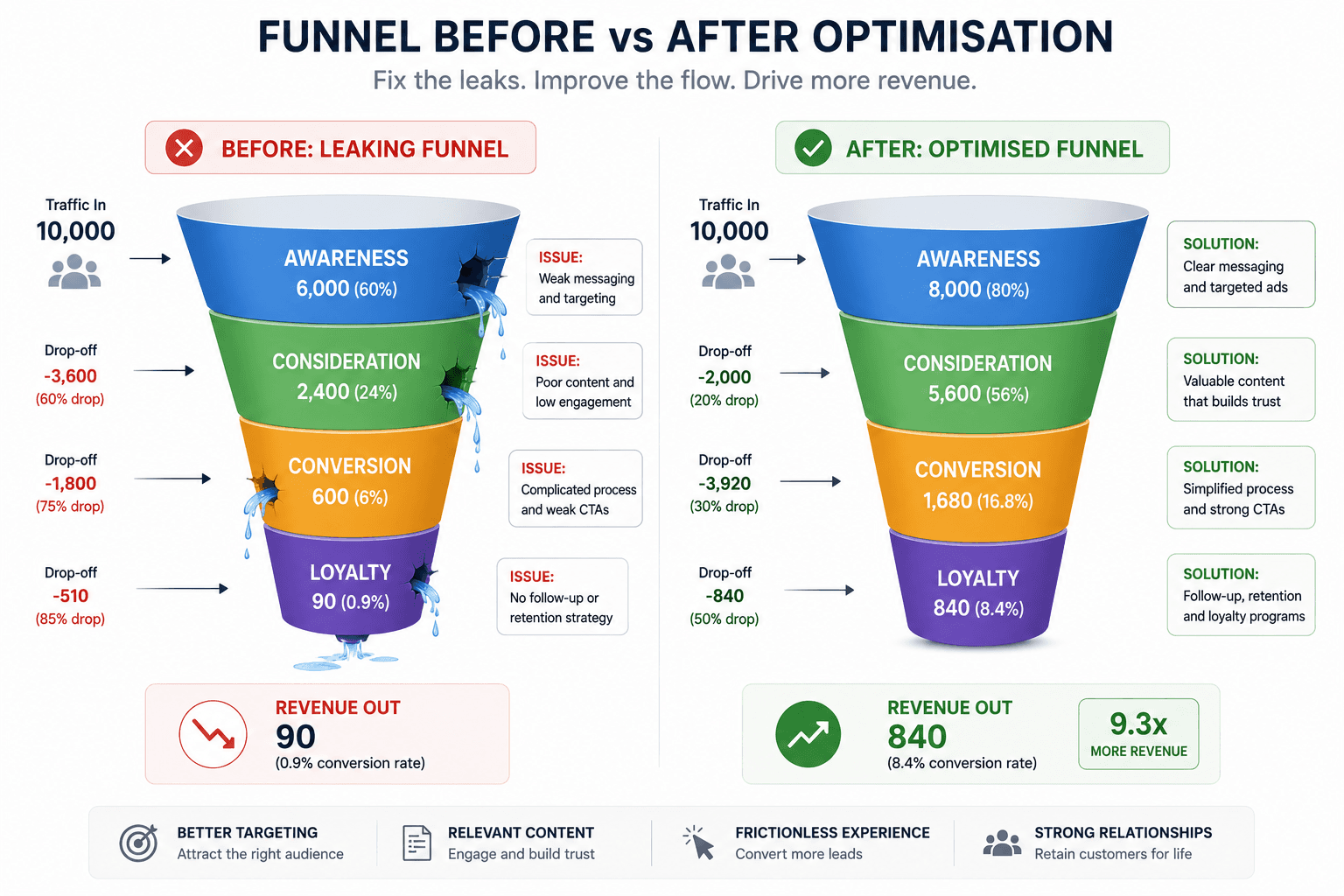
Find where people are currently dropping off. High bounce rate on the landing page? Nobody opening your emails? People adding to cart but not finishing? Each of these tells you exactly where the funnel has a hole.
Stat: Mapping the customer journey reduces cost of service by 15 to 20% and meaningfully improves marketing ROI. (McKinsey)
5.The Metrics That Show You Where You Are Losing People
You cannot fix what you do not measure. Here is what to watch at each stage.
Top of funnel click-through rate and cost per click. Low CTR usually means the creative or targeting is off. High CPC with low engagement means you are competing for the wrong audience.
Middle of funnel bounce rate and time on page. If people are landing and immediately leaving, the page is not matching what the ad promised. Low email open rates here mean your nurture content is not connecting.
Bottom of funnel conversion rate and cart abandonment. The numbers here are sobering.
Stat: Around 70% of people who add something to a cart never complete the purchase. (Baymard Institute)
Stat: The average landing page converts at just 2.35% the top performers hit 5.31% and above. (WordStream)
If you are sitting below average at any stage, that is where your attention should go before you spend another rupee on ads.
How to Fix Each Stage
Top of funnel underperforming? Your message is not landing. Test different angles lead with a pain point, try curiosity, focus on the outcome. New visuals, tighter audience. Do not keep running the same ad and hoping for different results.
Middle of funnel losing people? Your landing page needs to work harder. Sharpen what you are offering so it is immediately clear. Add genuine social proof real reviews, specific results, not just logos. Build a follow-up sequence that brings back the people who were not ready the first time.
Bottom of funnel with high drop-off? Remove friction everywhere. Fewer form fields. Clearer steps. A guarantee that reduces the risk of saying yes. Cart abandonment emails for anyone who got close but did not finish.
Stat: Abandonment email sequences recover between 5 and 11% of lost sales. (Moosend)
And across all stages keep testing. A funnel is never finished. Small improvements to a headline, a button, a page layout compound into significantly better results over months.
Stat: Consistent A/B testing improves landing page conversion rates by up to 300% over time. (VWO)
Frequently Asked Questions
1. What is a digital funnel in simple terms?
It is the journey someone takes from first hearing about your business to actually buying. Building one means having a deliberate system at every step not just an ad pointed at a homepage.
2. Should I build the funnel before running ads?
Always. Even a basic setup a focused landing page and a simple follow-up email will outperform sending paid traffic somewhere with no nurture in place.
3. Which stage of the funnel matters most?
All of them, but the middle gets neglected most often. Most brands invest in attention and in closing but do very little to build trust in between. That is where leads quietly disappear.
4. How do I know which part needs fixing?
Follow the drop-off. Where are people leaving? High bounce on landing means top-to-middle is broken. Low conversion at checkout means the bottom needs work. The data points you in the right direction.
5. Can a small business with a tight budget still build a proper funnel?
Yes and they arguably need one more than anyone else. A small budget against a well-built funnel will outperform a large budget with no structure behind it, every single time.
Why Performance Marketing Fails Without a Strong Digital Funnel
You launched the campaign. The ads look great. Clicks are coming in.
Then you check your sales. Nothing.
This happens to businesses constantly and most of them blame the ads. They tweak the creative, adjust the audience, increase the budget. Results barely move. Because the ads were never the problem. What sits between the ad and the sale is where the real issue lives. And most businesses have never properly built it.
1.What a Digital Funnel Actually Looks Like
Strip away the jargon and a digital funnel is a simple idea. It is the path someone travels from not knowing you exist to eventually buying from you. It is called a funnel because at every step, some people fall away you start wide at the top and end with buyers at the bottom.
There are three stages, and each one has a completely different job.
At the top, people are just discovering you. They saw your ad, came across your content, or heard your name somewhere. They are curious at best. Nowhere near ready to buy.
In the middle, things get more serious. These people are now comparing options visiting your site, reading reviews, checking out competitors. This is the stage where trust either gets built or does not.
At the bottom, the decision is happening. Someone has decided they want what you offer. Now it comes down to whether the experience of actually buying is smooth enough to close things out.
Stat: Brands with a clearly defined customer journey see a 54% higher return on marketing spend. (McKinsey)
Stat: It takes an average of 6 to 8 touchpoints before someone becomes a customer. One ad almost never does it alone. (Salesforce)
2.The Mistakes That Quietly Drain Your Budget
Most businesses running ads are not making obvious errors. The problems are subtler and harder to catch because on the surface, things look like they are working.
Sending everyone to the homepage is probably the most common one. Your homepage introduces your brand to everyone. A paid ad brings in someone with a very specific intent. Those two things do not match, and people bounce almost immediately.
Skipping the middle of the funnel is another costly habit. Brands run awareness campaigns at the top and retargeting at the bottom but put nothing in between. No emails, no nurture content, no reason for someone to stay interested between their first visit and their eventual decision. That gap is where most leads disappear.
Assuming one visit will convert is where a lot of budget silently burns.
Stat: 96% of people who land on your website are not ready to buy on that first visit. (Marketo)
If there is no system to bring them back no follow-up, no retargeting, no email sequence that click is gone forever. You paid for it and got nothing from it.
A slow or confusing landing page finishes off what the ad started. Creative and targeting can only carry someone so far.
Stat: A single second delay in page load time reduces conversions by up to 7%. (Akamai)
3.The Hard Truth About Ad Spend Without a Funnel
Running performance marketing without a funnel is not really a strategy. It is paying for a queue of people to walk up to a door that does not open.
The ad does its job. It creates a click, brings someone into your world. But the moment they arrive, there is nothing there to catch them. No clear next step. No reason to stay. No follow-up when they leave. And you still pay for every one of those clicks.
A digital funnel is the infrastructure that makes ads actually work. Without it, you are buying traffic not building a customer base.
Stat: Businesses using proper funnel strategies generate 451% more qualified leads than those without one. (The Annuitas Group)
Stat: 79% of marketing leads never convert not because they were poor leads, but because no one nurtured them. (HubSpot)
Stat: Leads that go through a nurture sequence spend 47% more on their first purchase. (The Annuitas Group)
The businesses consistently winning at performance marketing are not running the cleverest ads. They have built the strongest systems behind those ads.
4.Map the Customer Journey Before You Run a Single Ad
This is the step most businesses skip. Before setting a budget or writing a line of copy, you need to genuinely understand the journey your customer takes not the one you assume they take.
Get specific about who you are talking to. Not a broad demographic. What does this person worry about? What has already frustrated them about finding a solution? What would make them trust you enough to take the next step?
Map every touchpoint. Google, Instagram, a friend's recommendation, a YouTube ad. Each one is an entry point into your funnel at a different level of awareness.
Think about what they are asking at each stage. Early on the question is "what even is this?" In the middle it becomes "is this right for me?" At the bottom it shifts to "can I actually trust these people?" Your content and ads need to answer whichever question is most relevant in that moment.
Find where people are currently dropping off. High bounce rate on the landing page? Nobody opening your emails? People adding to cart but not finishing? Each of these tells you exactly where the funnel has a hole.
Stat: Mapping the customer journey reduces cost of service by 15 to 20% and meaningfully improves marketing ROI. (McKinsey)
5.The Metrics That Show You Where You Are Losing People
You cannot fix what you do not measure. Here is what to watch at each stage.
Top of funnel click-through rate and cost per click. Low CTR usually means the creative or targeting is off. High CPC with low engagement means you are competing for the wrong audience.
Middle of funnel bounce rate and time on page. If people are landing and immediately leaving, the page is not matching what the ad promised. Low email open rates here mean your nurture content is not connecting.
Bottom of funnel conversion rate and cart abandonment. The numbers here are sobering.
Stat: Around 70% of people who add something to a cart never complete the purchase. (Baymard Institute)
Stat: The average landing page converts at just 2.35% the top performers hit 5.31% and above. (WordStream)
If you are sitting below average at any stage, that is where your attention should go before you spend another rupee on ads.
How to Fix Each Stage
Top of funnel underperforming? Your message is not landing. Test different angles lead with a pain point, try curiosity, focus on the outcome. New visuals, tighter audience. Do not keep running the same ad and hoping for different results.
Middle of funnel losing people? Your landing page needs to work harder. Sharpen what you are offering so it is immediately clear. Add genuine social proof real reviews, specific results, not just logos. Build a follow-up sequence that brings back the people who were not ready the first time.
Bottom of funnel with high drop-off? Remove friction everywhere. Fewer form fields. Clearer steps. A guarantee that reduces the risk of saying yes. Cart abandonment emails for anyone who got close but did not finish.
Stat: Abandonment email sequences recover between 5 and 11% of lost sales. (Moosend)
And across all stages keep testing. A funnel is never finished. Small improvements to a headline, a button, a page layout compound into significantly better results over months.
Stat: Consistent A/B testing improves landing page conversion rates by up to 300% over time. (VWO)
Frequently Asked Questions
1. What is a digital funnel in simple terms?
It is the journey someone takes from first hearing about your business to actually buying. Building one means having a deliberate system at every step not just an ad pointed at a homepage.
2. Should I build the funnel before running ads?
Always. Even a basic setup a focused landing page and a simple follow-up email will outperform sending paid traffic somewhere with no nurture in place.
3. Which stage of the funnel matters most?
All of them, but the middle gets neglected most often. Most brands invest in attention and in closing but do very little to build trust in between. That is where leads quietly disappear.
4. How do I know which part needs fixing?
Follow the drop-off. Where are people leaving? High bounce on landing means top-to-middle is broken. Low conversion at checkout means the bottom needs work. The data points you in the right direction.
5. Can a small business with a tight budget still build a proper funnel?
Yes and they arguably need one more than anyone else. A small budget against a well-built funnel will outperform a large budget with no structure behind it, every single time.
Copyright © 2026 Tapitt. All rights reserved. • Privacy Policy
Copyright © 2026 Tapitt. All rights reserved. • Privacy Policy
Copyright © 2026 Tapitt. All rights reserved. • Privacy Policy