Why Post-Launch Support is the Most Underrated Part of Building a Website
Why Post-Launch Support is the Most Underrated Part of Building a Website
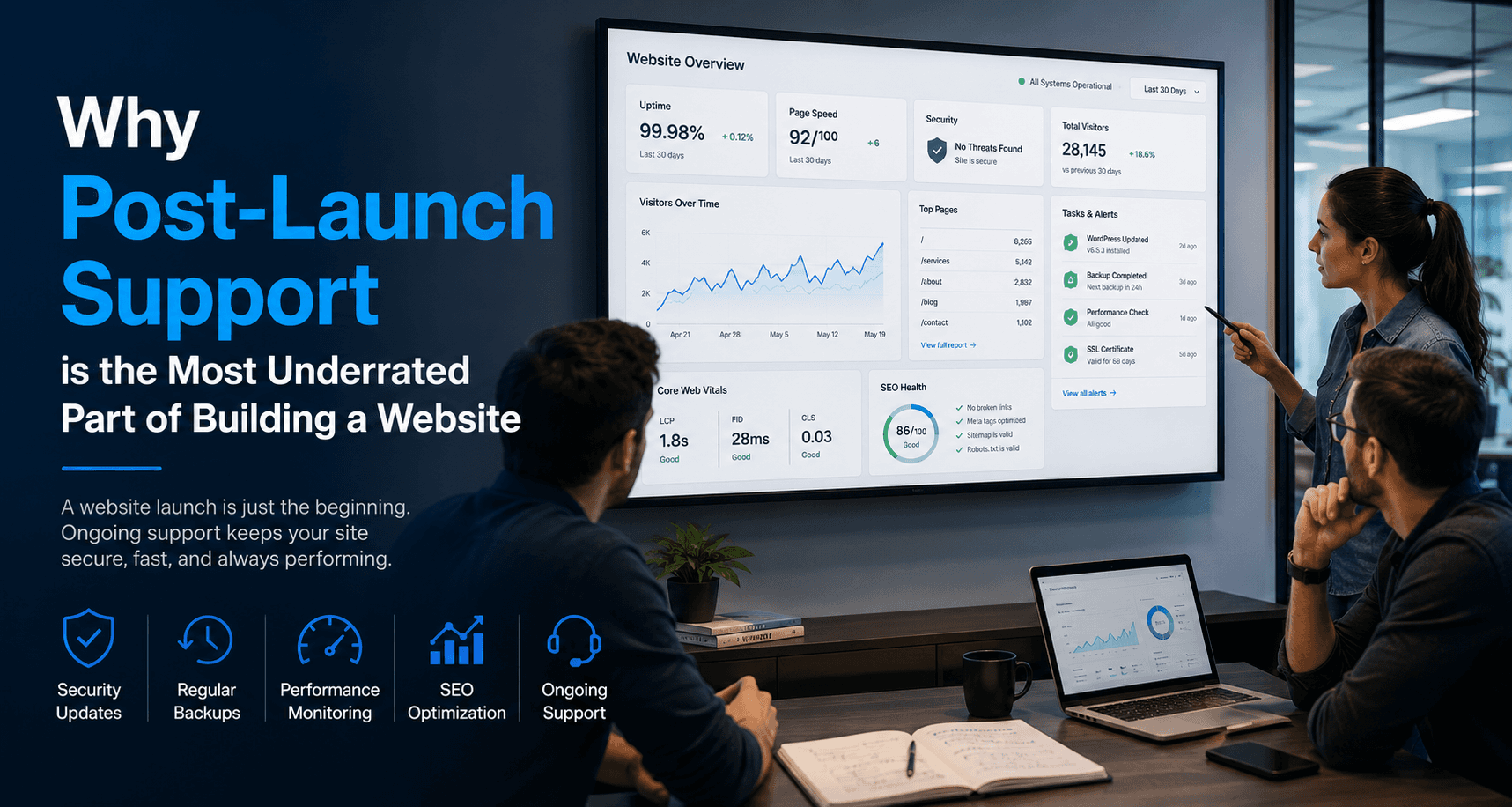
Why Post-Launch Support is the Most Underrated Part of Building a Website
There's a moment every business owner knows well the website goes live, the team celebrates, and everyone breathes a sigh of relief. The hard part is over, right?
Not quite.
What happens after launch is often what separates a website that quietly drives growth from one that slowly becomes a liability. And yet, post-launch support is consistently the last thing on most people's budget list. After years of working with businesses on their web development services, we've seen the same pattern play out repeatedly: the launch gets all the attention, and the ongoing care gets none.

1.What Typically Goes Wrong After a Website Goes Live
The first few weeks post-launch feel smooth. Then, gradually, things start to slip.
Plugins fall out of date. A browser update subtly breaks a contact form. The homepage loads fine on desktop but something's off on mobile. A new team member updates a page and accidentally removes a button. None of these are dramatic failures on their own but they add up fast, and most businesses don't catch them until a customer complains.
For companies offering custom web development, building the site is genuinely the more technical half of the job. But it's not the whole job. A website isn't a brochure you print once it's a living system that needs regular attention to keep performing the way it should.
2.The Hidden Costs of No Post-Launch Support
Here's what most people don't calculate when they skip ongoing support: the cost of not having it.
An unpatched plugin can create a security vulnerability that takes your site down entirely and data recovery, reputation repair, and redevelopment can cost many times what a monthly maintenance plan would have. A broken checkout page on an e-commerce site loses sales by the hour. A slow-loading site quietly kills your SEO rankings and sends visitors to competitors.
Any web development company worth working with will tell you that websites depreciate without care. Skipping maintenance doesn't save money it defers cost into something far more expensive.
3.Security, Updates, and Why They Can't Be Ignored
This one is non-negotiable.
WordPress, for example, powers a significant portion of the web. It's also one of the most frequently targeted platforms by automated bots scanning for outdated plugins and themes. The same applies to custom frameworks outdated dependencies are a genuine risk, not a theoretical one.
A proper post-launch support plan keeps your CMS, plugins, and server environment up to date on a defined schedule. It includes regular backups so that if something does go wrong, recovery is a matter of hours rather than days. For businesses relying on their site to generate leads or sell online especially those working with a web development company in Vadodara or anywhere else this isn't optional infrastructure. It's basic protection.
4.How Ongoing Support Improves Website Performance
Beyond security, consistent post-launch support actually makes your site better over time.
Page speed is one of the clearest examples. Images get added, new features go in, third-party scripts accumulate and without regular performance audits, load times creep upward. A site that launched at 90/100 on Google's speed score can quietly drop to 65 within a year if no one's watching.
The same goes for SEO. Search engines reward sites that stay fresh, load fast, and don't have broken links. A website development company in Vadodara or any agency should ideally include basic health checks as part of their ongoing relationship, not just the initial build. These small, consistent improvements compound into meaningful ranking and conversion gains over months.
5.What to Look for in a Post-Launch Support Plan
Not all support plans are created equal. Some agencies offer a vague "maintenance package" that amounts to monthly plugin updates and nothing else. What you actually want is something more purposeful.
A good post-launch support plan includes:
Regular security scans and updates not just CMS updates, but hosting-level security too
Uptime monitoring so you're the first to know when something goes down, not your customers
Scheduled performance audits checking speed, broken links, and mobile responsiveness
Content update support quick turnaround on small changes so your team isn't blocked
Monthly reporting so you can see what's been done and how the site is performing
If you've invested in custom web app development services, your support requirements will be more complex custom code has no automatic update path, and without proactive maintenance, technical debt accumulates silently.
6.Questions to Ask Your Agency Before Signing Off
Before you hand over final sign-off on a project or before you hire a web development company USA-based or local ask these questions:
What happens if the site breaks after launch? What's the response time, and is it included or billed separately?
Who owns the backups? Where are they stored, and how often are they taken?
How are updates handled? Who's responsible for keeping plugins, themes, and core software current?
What does a typical support request look like? Is there a ticketing system? A dedicated contact?
Can I see an example of your monthly reporting? Transparency here tells you a lot about how an agency operates.
If the answers feel vague or off-the-cuff, that's a signal. The best agencies build post-launch support into their workflow as a standard not as an afterthought you have to chase.
7.The Real Point
A website launch is a beginning, not a finish line.
The businesses that treat their website as an ongoing asset something to maintain, improve, and build on consistently outperform those that treat it as a one-time project. Whether you're working with a web and mobile development services provider on a full digital ecosystem, or you've just launched a straightforward brochure site, the principle is the same: what you do after launch determines what the launch was actually worth.
Post-launch support isn't glamorous. It doesn't come with a celebration. But it's what keeps the site you worked hard to build actually working for your customers, and for your business.
Frequently Asked Questions
1. How soon after launch does a website need support?
Almost immediately. The first few weeks are when small issues surface browser compatibility, form errors, minor display problems. Having a support plan in place from day one means these get caught and fixed before customers notice.
2. How much does post-launch support typically cost?
It varies significantly by site complexity, but most businesses find a structured plan far cheaper than the cost of fixing a single major issue whether that's a security breach, a broken checkout, or emergency redevelopment work.
3. Can't my internal team handle website maintenance?
For basic content updates, often yes. But security patching, performance optimization, and server-level maintenance typically require technical expertise that most in-house teams don't have readily available. A hybrid approach internal content management, external technical support is common and works well.
4. What if my website was built by a different agency?
Most reputable agencies will take over support for existing sites after a brief audit. It's worth getting that audit done you'd be surprised what goes unnoticed for months on a site with no active maintenance.
Why Post-Launch Support is the Most Underrated Part of Building a Website
There's a moment every business owner knows well the website goes live, the team celebrates, and everyone breathes a sigh of relief. The hard part is over, right?
Not quite.
What happens after launch is often what separates a website that quietly drives growth from one that slowly becomes a liability. And yet, post-launch support is consistently the last thing on most people's budget list. After years of working with businesses on their web development services, we've seen the same pattern play out repeatedly: the launch gets all the attention, and the ongoing care gets none.
1.What Typically Goes Wrong After a Website Goes Live
The first few weeks post-launch feel smooth. Then, gradually, things start to slip.
Plugins fall out of date. A browser update subtly breaks a contact form. The homepage loads fine on desktop but something's off on mobile. A new team member updates a page and accidentally removes a button. None of these are dramatic failures on their own but they add up fast, and most businesses don't catch them until a customer complains.
For companies offering custom web development, building the site is genuinely the more technical half of the job. But it's not the whole job. A website isn't a brochure you print once it's a living system that needs regular attention to keep performing the way it should.
2.The Hidden Costs of No Post-Launch Support
Here's what most people don't calculate when they skip ongoing support: the cost of not having it.
An unpatched plugin can create a security vulnerability that takes your site down entirely and data recovery, reputation repair, and redevelopment can cost many times what a monthly maintenance plan would have. A broken checkout page on an e-commerce site loses sales by the hour. A slow-loading site quietly kills your SEO rankings and sends visitors to competitors.
Any web development company worth working with will tell you that websites depreciate without care. Skipping maintenance doesn't save money it defers cost into something far more expensive.
3.Security, Updates, and Why They Can't Be Ignored
This one is non-negotiable.
WordPress, for example, powers a significant portion of the web. It's also one of the most frequently targeted platforms by automated bots scanning for outdated plugins and themes. The same applies to custom frameworks outdated dependencies are a genuine risk, not a theoretical one.
A proper post-launch support plan keeps your CMS, plugins, and server environment up to date on a defined schedule. It includes regular backups so that if something does go wrong, recovery is a matter of hours rather than days. For businesses relying on their site to generate leads or sell online especially those working with a web development company in Vadodara or anywhere else this isn't optional infrastructure. It's basic protection.
4.How Ongoing Support Improves Website Performance
Beyond security, consistent post-launch support actually makes your site better over time.
Page speed is one of the clearest examples. Images get added, new features go in, third-party scripts accumulate and without regular performance audits, load times creep upward. A site that launched at 90/100 on Google's speed score can quietly drop to 65 within a year if no one's watching.
The same goes for SEO. Search engines reward sites that stay fresh, load fast, and don't have broken links. A website development company in Vadodara or any agency should ideally include basic health checks as part of their ongoing relationship, not just the initial build. These small, consistent improvements compound into meaningful ranking and conversion gains over months.
5.What to Look for in a Post-Launch Support Plan
Not all support plans are created equal. Some agencies offer a vague "maintenance package" that amounts to monthly plugin updates and nothing else. What you actually want is something more purposeful.
A good post-launch support plan includes:
Regular security scans and updates not just CMS updates, but hosting-level security too
Uptime monitoring so you're the first to know when something goes down, not your customers
Scheduled performance audits checking speed, broken links, and mobile responsiveness
Content update support quick turnaround on small changes so your team isn't blocked
Monthly reporting so you can see what's been done and how the site is performing
If you've invested in custom web app development services, your support requirements will be more complex custom code has no automatic update path, and without proactive maintenance, technical debt accumulates silently.
6.Questions to Ask Your Agency Before Signing Off
Before you hand over final sign-off on a project or before you hire a web development company USA-based or local ask these questions:
What happens if the site breaks after launch? What's the response time, and is it included or billed separately?
Who owns the backups? Where are they stored, and how often are they taken?
How are updates handled? Who's responsible for keeping plugins, themes, and core software current?
What does a typical support request look like? Is there a ticketing system? A dedicated contact?
Can I see an example of your monthly reporting? Transparency here tells you a lot about how an agency operates.
If the answers feel vague or off-the-cuff, that's a signal. The best agencies build post-launch support into their workflow as a standard not as an afterthought you have to chase.
7.The Real Point
A website launch is a beginning, not a finish line.
The businesses that treat their website as an ongoing asset something to maintain, improve, and build on consistently outperform those that treat it as a one-time project. Whether you're working with a web and mobile development services provider on a full digital ecosystem, or you've just launched a straightforward brochure site, the principle is the same: what you do after launch determines what the launch was actually worth.
Post-launch support isn't glamorous. It doesn't come with a celebration. But it's what keeps the site you worked hard to build actually working for your customers, and for your business.
Frequently Asked Questions
1. How soon after launch does a website need support?
Almost immediately. The first few weeks are when small issues surface browser compatibility, form errors, minor display problems. Having a support plan in place from day one means these get caught and fixed before customers notice.
2. How much does post-launch support typically cost?
It varies significantly by site complexity, but most businesses find a structured plan far cheaper than the cost of fixing a single major issue whether that's a security breach, a broken checkout, or emergency redevelopment work.
3. Can't my internal team handle website maintenance?
For basic content updates, often yes. But security patching, performance optimization, and server-level maintenance typically require technical expertise that most in-house teams don't have readily available. A hybrid approach internal content management, external technical support is common and works well.
4. What if my website was built by a different agency?
Most reputable agencies will take over support for existing sites after a brief audit. It's worth getting that audit done you'd be surprised what goes unnoticed for months on a site with no active maintenance.
Copyright © 2026 Tapitt. All rights reserved. • Privacy Policy
Copyright © 2026 Tapitt. All rights reserved. • Privacy Policy
Copyright © 2026 Tapitt. All rights reserved. • Privacy Policy